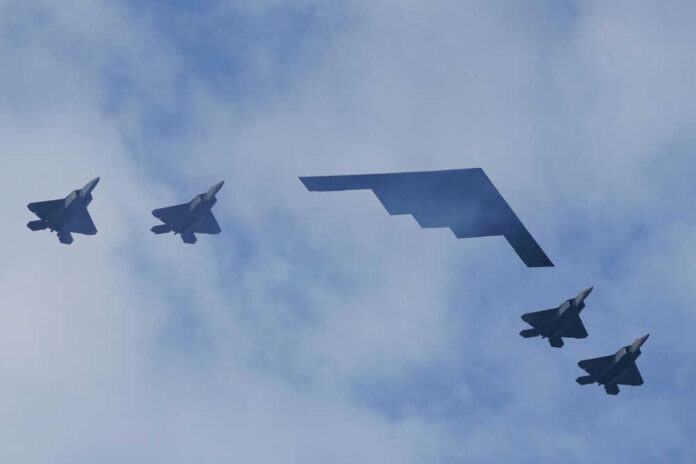
(RightWardpress.com) – Poland’s swift interception of a Russian reconnaissance plane highlights the delicate dance of airspace defense in the Baltic region.
Story Overview
- Polish fighter jets intercepted a Russian reconnaissance aircraft over the Baltic Sea.
- Unidentified objects, likely smuggling balloons, entered Polish airspace from Belarus.
- Part of Polish airspace was temporarily closed as a precaution.
- Incidents underscore NATO’s vigilance amid regional tensions.
Poland’s Strategic Response to Airspace Intrusions
On December 25, 2025, Polish fighter jets intercepted a Russian reconnaissance aircraft over international waters near Polish airspace. The Polish Armed Forces acted decisively, demonstrating their readiness to secure NATO’s eastern flank. As tensions with Russia remain high, this incident underscores Poland’s commitment to maintaining airspace integrity amidst potential threats. The interception occurred over the Baltic Sea, an area frequently patrolled by Russian military aircraft, often testing the limits of NATO’s response protocols.
During the same period, Polish air defense systems detected unidentified objects entering from Belarus. These were later identified as likely smuggling balloons, highlighting the complex nature of modern airspace threats that blend military and non-military elements. The Polish Operational Command monitored these objects closely, showcasing the nation’s advanced radar capabilities and strategic vigilance. This dual-threat scenario—both military and hybrid—illustrates the multifaceted challenges Poland faces on NATO’s frontline.
The Geopolitical Implications
The interception of the Russian plane and the intrusion of airborne objects come against a backdrop of increased aerial activity in the Baltic region. Since Russia’s full-scale invasion of Ukraine, Poland has amplified its defense measures, given its strategic position as a NATO member and a direct neighbor to the conflict. Poland’s response reflects a broader NATO strategy to deter any aggressive maneuvers by Russia and to prevent potential escalations that could arise from airspace violations.
Poland’s decision to temporarily close part of its airspace over the Podlaskie region is a precautionary measure that underscores the serious nature of these incursions. The region, bordering Belarus, has been a corridor for smuggling and hybrid activities, complicating the security landscape. By closing the airspace, Poland not only ensures civilian safety but also sends a strong message about its readiness to act decisively in the face of potential threats.
NATO’s Eastern Flank: A Constant Vigil
These events are part of a pattern of Russian provocations along NATO’s eastern borders. In recent months, Russian military jets have repeatedly violated the airspace of NATO countries, raising concerns about the potential for accidental or deliberate escalations. Poland’s rapid response to both the reconnaissance aircraft and the smuggling balloons demonstrates its capability and willingness to defend its airspace and contribute to NATO’s collective defense posture.
For Poland, these incidents reinforce the importance of maintaining a robust air defense system capable of handling diverse threats. They also highlight the strategic value of the Baltic Sea region as a critical theater for both NATO and Russian military operations. As Poland continues to strengthen its defenses, these encounters serve as a reminder of the ongoing geopolitical tensions that define the region.
Sources:
Polskie Radio – Polish fighter jets intercept Russian reconnaissance plane
Ukrinform – Poland intercepts Russian reconnaissance aircraft over Baltic Sea
Straits Times – Poland intercepts Russian plane over Baltic Sea
Global Banking & Finance Review – Ukraine crisis: Russia aircraft
Copyright 2025, RightWardpress.com